service@lencolo37.com |
+86 18027002837(WhatsApp)

Search for Products.
Introduction
Standard film substrates — including PET, PC, PMMA, and composite films — are widely used in modern product design, from smartphone displays and automotive interiors to decorative and optical applications. Their transparency, flexibility, and lightweight properties make them highly versatile.
However, these materials remain vulnerable to scratching, abrasion, contamination, and gradual surface degradation during use.
UV hard coating technology provides an effective solution by creating a transparent protective layer that enhances durability, preserves appearance, and improves overall surface performance.
The Three Dimensions of Film Surface Protection
Protecting film substrates is not simply about making the surface harder. Effective UV hard coating systems are designed to address three challenges simultaneously: mechanical durability, environmental resistance, and surface performance.
1. Mechanical Protection: More Than Scratch Resistance
Scratch resistance is often the first requirement for film applications, but real-world durability involves much more than resisting occasional contact. Film surfaces must tolerate repeated friction, cleaning cycles, daily handling, and continuous wear without losing their protective function. Modern UV hard coating systems achieve this balance through optimized resin design and controlled cross-linking structures, delivering enhanced hardness while maintaining long-term durability. Different performance levels can also be achieved depending on application requirements — from standard protective coatings to high-hardness and wear-resistant systems.
2. Chemical and Environmental Protection
Film surfaces are continuously exposed to environmental stress factors including cleaning agents, skin oils, cosmetics, UV exposure, temperature variation, and humidity. Without proper protection, these influences may cause surface degradation, appearance changes, or reduced service life. UV hard coatings help create a stable barrier layer that improves resistance to external conditions and supports long-term surface reliability across demanding environments. This makes them suitable for applications ranging from consumer electronics and decorative films to automotive and outdoor-use surfaces.
3. Surface Aesthetics and Functional Enhancement
Protection alone is not enough. Modern film applications demand surfaces that remain visually appealing and deliver a premium tactile experience. An effective hard coating should preserve transparency, minimize haze, maintain smooth touch, and support the intended appearance of the substrate.
Today’s advanced UV hard coating technologies go beyond protection by integrating additional functionalities such as:
Anti-fingerprint performance
Easy-clean surfaces
Anti-soiling effects
Improved surface feel
As a result, coatings become not only a protective layer but also a contributor to overall product value.
Why Film Substrates Need a System-Level “Shield”
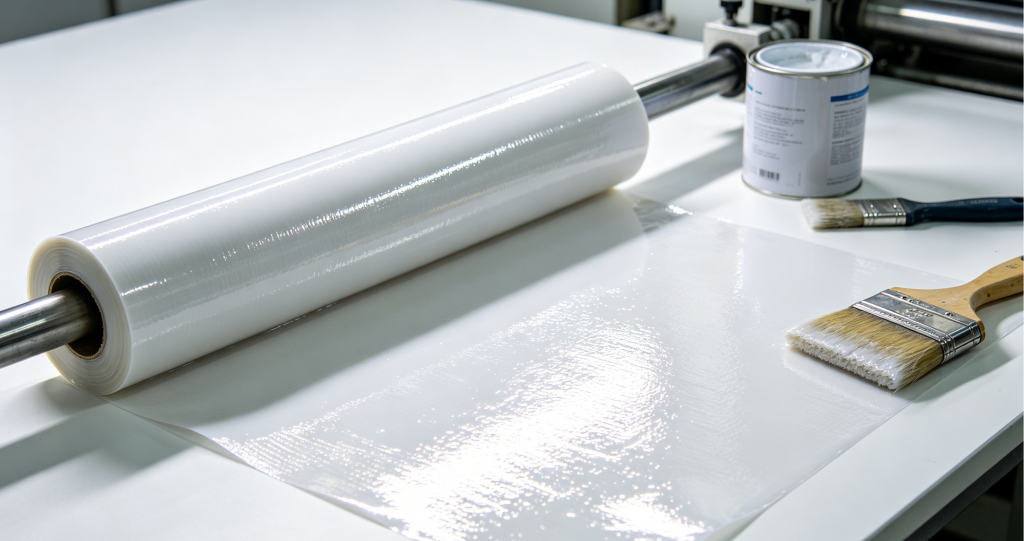
PET, PC, and PMMA are naturally low-surface-energy materials, which makes achieving durable coating adhesion more challenging. Many conventional hard coating systems focus heavily on hardness but overlook adhesion performance, leading to issues such as cracking, peeling, or delamination during use.
A successful hard coating solution requires a complete system approach that combines:
Surface preparation and pretreatment
Suitable primer design (when required)
Proper resin selection
Balanced hardness and flexibility
Controlled curing condition
Only by optimizing these factors together can coating performance remain stable throughout the product lifecycle. Next-Generation UV Hard Coatings: From Protection to Multi-functionality UV hard coating technology has evolved significantly in recent years through improvements in resin design, photoinitiator compatibility, and curing efficiency.
Modern coating systems provide a wider range of performance profiles to meet different application demands, including:
Standard hard coating systems with good Processing capacity
High-hardness scratch-resistant coatings
Wear-resistant and anti-soiling systems
Functional coatings with enhanced surface performance
More importantly, next-generation coatings are increasingly designed to integrate multiple functions into a single layer, reducing process complexity while improving overall efficiency. Depending on application requirements, different resin architectures and formulation approaches can be selected to achieve the desired balance between protection, appearance, and usability.
Applications: Where the Invisible Shield Creates Value
UV hard coating technology has become a foundational capability across multiple industries:
Consumer Electronics
Display panels, touch screen protectors, mobile phone films, laptop surfaces, and wearable device components.
Automotive
Interior decorative films and exterior protective surfaces exposed to repeated contact, UV radiation, and environmental stress.
Optical and Functional Films
Transparent films requiring surface durability without compromising optical performance.
Decorative and Industrial Surfaces
High-end decorative applications that demand both appearance retention and long-term protection.
Selecting the Right UV Hard Coating System
No single coating system fits every substrate.
Selecting the right solution depends on multiple factors, including:
Film type (PET / PC / PMMA / composite films)
Target hardness level
Adhesion requirements
Surface functionality
Processing method
Final application environment
A well-designed UV hard coating should not only protect the substrate but also enhance the overall user experience and extend product value.
If you are developing coatings for film applications, selecting the appropriate resin system and formulation strategy early in the design stage can significantly improve long-term performance and production efficiency.
#UVHardCoating #HardCoating #PETFilm #PCFilm #PMMAFilm #ScratchResistance #SurfaceProtection #UVCurableCoating #ProtectiveFilm #FunctionalCoating #UVHardCoating #HardCoatingResin #FilmCoating #ScratchResistantCoating #AntiFingerprintCoating #ProtectiveFilm #UVResin #SurfaceEnhancement #FunctionalFilm #CoatingSolutions

2025-01-06
2022-08-03